

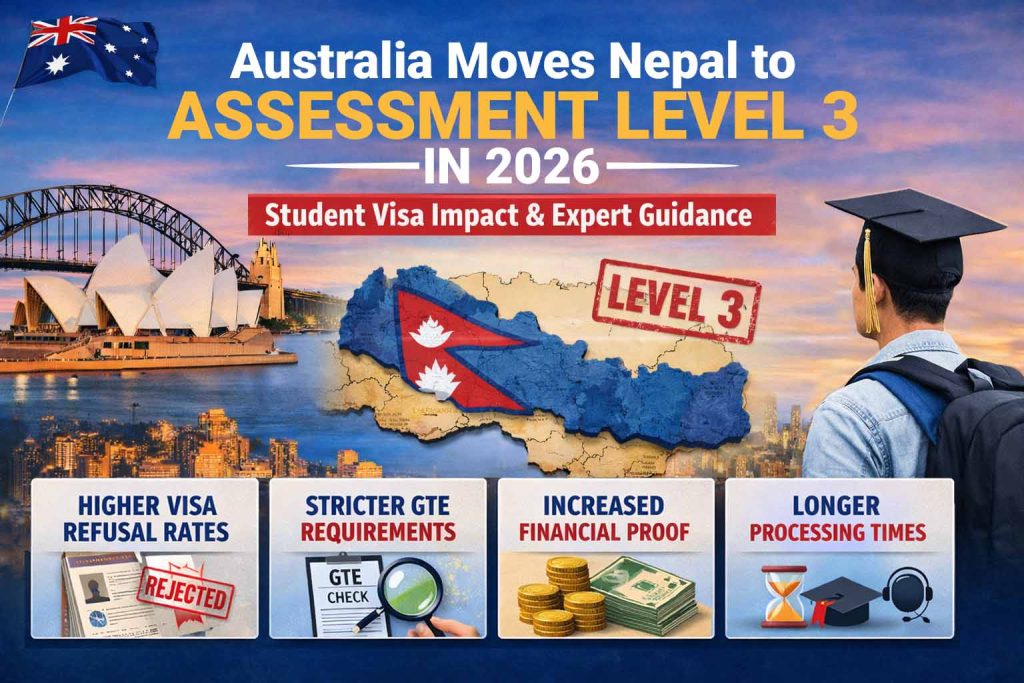
In a major policy shift with serious implications for international education, Australia has officially moved Nepal to Assessment Level 3 for student visa processing in 2026. This change, implemented by the Department of Home Affairs, directly affects Nepali students planning to study in Australia, including both onshore and offshore applicants.
With more than a decade of professional experience in student counselling across Australia, this article provides an analytical and evidence-based explanation of what this change means, why it occurred, and how students can still succeed under the updated framework.
What Is Australia’s Student Visa Assessment Level System?
Australia categorises student source countries into Assessment Levels 1, 2, and 3. These levels are determined using immigration risk indicators such as:
- Student visa refusal rates
- Non-genuine student trends
- Overstay and compliance records
- Protection and asylum-related data
Assessment Level 3 represents the highest level of immigration risk and results in stricter visa assessment under the Student (Subclass 500) visa framework.
Why Was Nepal Moved to Assessment Level 3 in 2026?
Based on policy trends and migration data analysis, several key factors contributed to Nepal’s reclassification.
1. Rising Student Visa Refusal Rates
In recent years, Nepali student visa refusal rates increased, particularly in:
- VET and non-university education sectors
- Applications with weak financial evidence
- Cases where course selection lacked academic progression
2. Increased Non-Genuine Student Findings
Australian immigration authorities identified a growing number of applicants whose:
- Study plans lacked logical academic continuity
- Primary intention appeared focused on work or migration rather than education
3. Compliance and Post-Study Behaviour
Data also showed:
- Higher levels of post-study visa non-compliance
- Increased onshore visa switching without academic justification
These combined indicators resulted in Nepal being placed under the highest assessment category as outlined in Australia’s migration and visa statistics.
Key Impacts on Nepali Students
Stricter Genuine Student Assessment
Applicants must now provide stronger evidence to meet Genuine Student requirements, including:
- Clear academic and career progression
- Strong relevance between past studies and chosen course
- Well-defined long-term career plans
Higher Financial Evidence Standards
Students are expected to demonstrate:
- Clearly verifiable income sources
- Longer financial history
- Transparent sponsor relationships
Longer Processing Timeframes
- Extended processing periods
- Requests for additional documents or interviews
Increased Refusal Risk if Applications Are Weak
Applications that are poorly structured or generic face a significantly higher chance of refusal under current visa processing standards.
Evidence-Based Insight From Counselling Experience
From extensive counselling of both onshore and offshore students, professional observations show:
- University sector applicants with strong academic profiles continue to receive approvals
- Students with clear study purpose statements, genuine finances, and realistic career plans remain competitive
- Poorly guided applications have shown refusal rate increases of up to 30–40 percent under Assessment Level 3
This confirms that Assessment Level 3 does not mean student visas are unavailable. It means applications must be stronger and better prepared.
How Nepali Students Can Still Succeed in 2026
Choose the Right Course and Institution
- Ensure strong alignment with previous education
- Prioritise universities and reputable education providers listed on Study in Australia
Prepare a Strong Genuine Student Statement
Your statement must clearly explain:
- Why this course was chosen
- Why Australia is the preferred destination
- Why study at this stage of life
- How the qualification supports long-term career outcomes
Maintain Complete Financial Transparency
Avoid shortcuts and provide:
- Genuine bank statements
- Income tax documents
- Salary certificates or business financials where applicable
Seek Professional Counselling
Assessment Level 3 applications require personalised strategy, not standard templates.
What This Means for Parents and Sponsors
Parents and sponsors should be prepared for:
- Increased scrutiny of income and asset documentation
- Verification of financial capacity and consistency
- Possible compliance checks or interviews
Accuracy, honesty, and clarity are now essential.
Final Thoughts
Australia’s decision to move Nepal to Assessment Level 3 in 2026 is a policy adjustment, not a closure of opportunity. It signals a stronger focus on quality students with genuine academic intent.
With expert guidance, well-prepared documentation, and realistic study planning, Nepali students can still achieve successful outcomes in Australia under the new assessment level.
Need Expert Guidance?
At Global Consult Australia, we specialise in:
- Assessment Level 3 student visa strategy
- Onshore and offshore student counselling
- University, VET, and pathway admissions
- Genuine Student statement preparation
Visit www.globalconsult.com.au to book a professional consultation and apply with confidence in 2026.
📍 Visit your nearest Global Consult office in Australia and Nepal.
Australia
-
- Sydney:📞 +61-2 8958 6749 📩 inquiry@globalconsult.com.au
-
- Canberra:📞 +61-2 6183 0811 📩 canberra@globalconsult.com.au
-
- Parramatta:📞 +61-2 8606 4243 | +61-466 195 227 📩 parramatta@globalconsult.com.au
-
- Perth:📞 +61-861 508 374 📩 perth.info@globalconsult.com.au
-
- Tasmania:📞 +61-3 6170 9952 | +61-466 312 719 📩 tasmania@globalconsult.com.au
-
- Rockdale:📞 +61-0452 073 123 📩 rockdale@globalconsult.com.au
Nepal
-
- New Baneshwor, Kathmandu:📞 9801166574 | 01-4106740 | 01-5910893 📩 application@globalconsult.com.au
-
- Putalisadak, Kathmandu:📞 01-4532604 | 9745723773 📩 putalisadak@globalconsult.com.au
-
- Pokhara:📞 9822777613 | 061- 591023 📩 pokhara@globalconsult.com.au
-
- Chitwan:📞 056- 510 240 📩 chitwan@globalconsult.com.au