
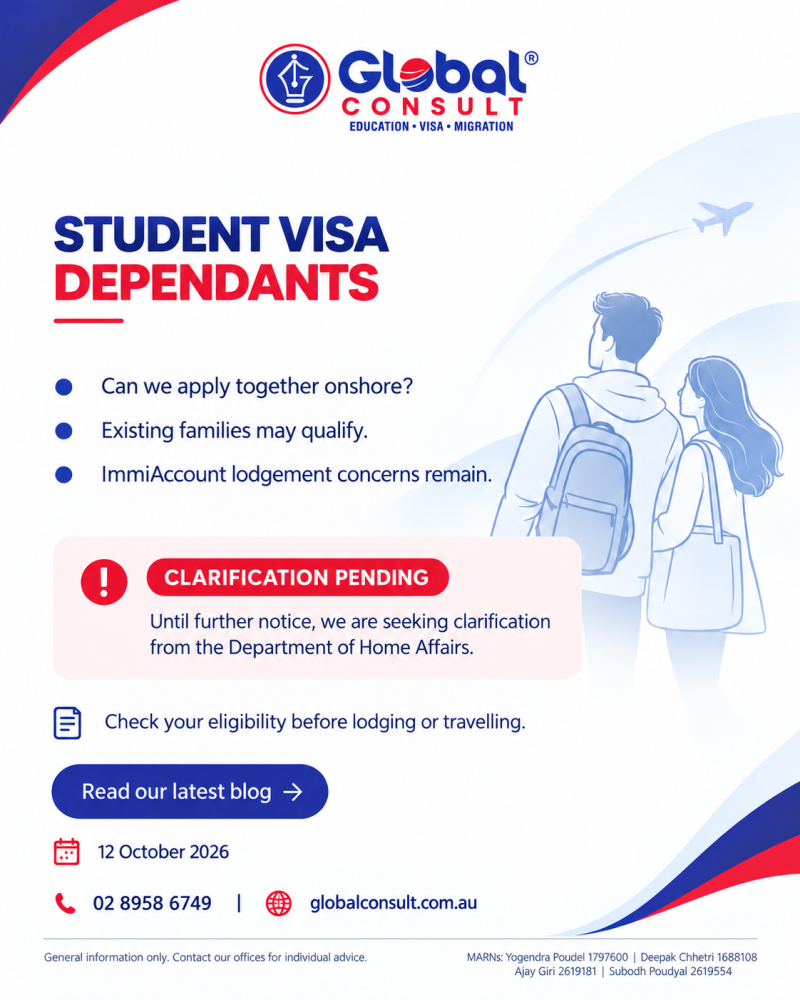
Department clarification pending. Existing Student visa families may qualify to apply together onshore when the primary student progresses to an eligible course. Until further notice, Global Consult is seeking clarification about the reported ImmiAccount lodgement concerns. General information only—contact our offices for advice about your circumstances.
Global Consult | Updated 12 October 2026
Until further notice, Global Consult is still seeking clarification from the Department of Home Affairs about combined onshore Student visa applications involving existing dependants and eligible course progression.
This article explains our preliminary reading of the legislation. It is not confirmation that the reported ImmiAccount block has been resolved or that any particular application will be accepted.
A common question is: “My partner is already in Australia as my Student visa dependant. I have completed my principal course and want to progress to another course. Can we apply together for another Student visa without leaving Australia?”
You have finished your course, found your next study option and want your family to remain together. Then the online visa application will not let you proceed with your dependant. Does the law prevent the application, or does the application need a closer review?
Our preliminary reading is that a qualifying existing dependant may be included in a combined onshore application. The primary student must qualify to apply onshore, and the dependant must independently meet the existing-family protection or another applicable exception. An ImmiAccount block has been reported in this situation; its cause has not been established.
Two separate eligibility checks
The first check concerns the primary student’s right to lodge in Australia. The second concerns the dependant’s right to be included. A course progression exception for the student is not, by itself, a new-family exception. However, an existing family may qualify through the transitional provisions.
When can the primary student rely on course progression?
Section 19 of the instrument amended by LIN 26/087 addresses eligible primary Student visa holders who have completed their principal course, or a permitted alternative principal course, and are enrolled in no more than one further course.
Where the completed course has an Australian Qualifications Framework (AQF) level, the next course must have a higher AQF level. If the completed course was higher education, the next course must also be higher education delivered by a higher education provider. Separate rules address courses without an AQF level.
For example, completing a bachelor’s degree and enrolling in a qualifying master’s degree may meet the progression requirements. The actual qualifications, enrolment, completion evidence and visa history must be checked.
When can the existing dependant be included?
Schedule 1, subparagraphs 1222(3)(da)(ii) and (iii), provide protection for certain existing Student visa families. A dependant may rely on these provisions where:
- They are in Australia when lodging the new application.
- They held a subclass 500 visa as a secondary applicant when the provisions commenced on 2 October 2026; or they applied for that secondary Student visa before commencement and it was granted on or after commencement.
- The primary applicant in the new application is the same person who met the primary criteria for that earlier Student visa.
They must remain an eligible member of that person’s family unit and meet the remaining application and visa requirements. Simply being in Australia, or being someone’s spouse, is insufficient.
The existing-family provision is not confined to PhD students or unfinished courses. It can operate alongside the primary student’s eligible course progression to a new course.
Apply together, at the same time and place
The dependant’s application must be combined with the primary student’s application. For an onshore application, both must be in Australia and individually eligible to lodge there. The family cannot lodge onshore and offshore separately as one combined application.
Do not plan to lodge a new Student subsequent-entrant application after the primary student’s visa is granted. That pathway has been removed under the new rules.
Examples of how the rules work
| Situation | Likely application position |
|---|---|
| Primary student completes a bachelor’s and enrols in an eligible higher-level master’s. Partner held a secondary Student visa at commencement. Both remain in Australia. | A combined onshore application may be valid if the same-primary, progression and other requirements are met. |
| Primary student completes one AQF-level master’s and enrols in another at the same AQF level. | This does not satisfy the higher-AQF course progression exception. Another applicable exception would need to be established. |
| Primary student qualifies for progression, but partner holds a 485, 482 or Visitor visa. | The partner cannot lodge a Student application onshore while holding that excluded visa. Family eligibility must also be assessed. |
| New spouse has no qualifying earlier secondary Student visa or pre-commencement application. | The existing-family protection does not apply. A different family exception would be needed. |
Do not confuse progression with completing unfinished studies
Course progression concerns a completed principal course followed by eligible further study. The separate completion provision concerns an unfinished principal course and completion within 12 months of the original CoE end date. Its same-provider requirements should not be substituted for the progression rules.
A routine provider change to finish a same-level course is not automatically course progression or an entitlement to lodge onshore. Provider default has its own separate conditions.
Does the dependant need to progress in their own studies?
When continuing as a secondary applicant, the dependant does not have to satisfy the primary student’s course progression exception. That assessment concerns the person applying as the primary student. A dependant who instead wants to become the primary Student visa applicant faces a different onshore restriction and should obtain separate advice.
What else needs checking?
Current visa status, visa conditions, any previous refusal or cancellation, and each person’s application validity must be assessed. LIN 26/102 excludes specified visa holders from onshore Student applications, including holders granted those visas as dependants. Relationship, financial, insurance, health, character and other applicable grant criteria also remain relevant. A valid application is not a guarantee of visa approval.
What should you do if ImmiAccount blocks the family application?
Do not assume the system message establishes a blanket ban, and do not assume every blocked application is a software error. Check the exact message, current visa status, application answers and the legal requirements for every applicant.
- Keep the full error screenshot, draft reference and dates of attempted lodgement.
- Gather both visa grant notices, the dependant’s earlier application and grant dates, relationship evidence, course completion evidence and the new CoE.
- Ask for technical assistance through the Department’s ImmiAccount Technical Support Form. Explain the proposed legal basis and request referral to the Student visa team where necessary.
- Obtain case-specific advice before the current visas expire. A support request is not a visa application and does not itself extend a visa or establish a bridging visa.
Do not lodge the primary application alone on the assumption that the dependant can join through a new subsequent-entrant application after grant. Do not make overseas travel plans without checking whether departure would affect the onshore existing-family protection.
What are we seeking clarification about?
We are seeking clarity on the practical lodgement process where the primary student relies on course progression and the existing dependant relies on 1222(3)(da)(ii) or (iii). The Department needs to distinguish that situation from a new family member without an applicable exception or a dependant seeking to become the primary student.
There is also an apparent cross-reference discrepancy: sections 20–23 of LIN 26/087 refer to 1222(3)(d)(vi), while the corresponding family provision in the Regulations is 1222(3)(da)(vi). Its legal significance requires clarification. We have not established that it causes the system block.
Until further notice, Department clarification remains pending. Contact our offices directly for a current assessment of your family’s circumstances.
Ask Global Consult to assess your family’s circumstances
Before lodging, ask our team to review both visa grant notices, the dependant’s earlier application and grant dates, course completion evidence, the new CoE and relationship documents.
02 8958 6749 | [email protected] | globalconsult.com.au
General information only, based on the supplied October 2026 reform documents and the corresponding legislative provisions. Contact our offices directly for advice about your circumstances before applying or making travel plans.
Official guidance and legal references
Home Affairs Student visa changes fact sheet states that existing Student visa families applying in Australia may be included in their next application, subject to eligibility.
- Migration Amendment (Student Visa Reform) Regulations 2026: Schedule 1 item 1222, especially paragraphs (3)(aa), (3)(da), (3)(e) and subitem (4). Its explanatory statement, items 7-10, explains the onshore and existing-family provisions.
- LIN 26/087: inserted sections 19 (course progression), 22 (family and provider default) and 23 (family and completion of studies).
- LIN 26/102: visa holders required to apply outside Australia.
- Migration Institute of Australia: Student visa onshore applications and family inclusion snapshot, generated 2 October 2026. This is a summary; the operative legislation determines eligibility.
Global Consult – Registered Migration Agents
MARNs: Yogendra Poudel 1797600 | Deepak Chhetri 1688108 | Ajay Giri 2619181 | Subodh Poudyal 2619554