
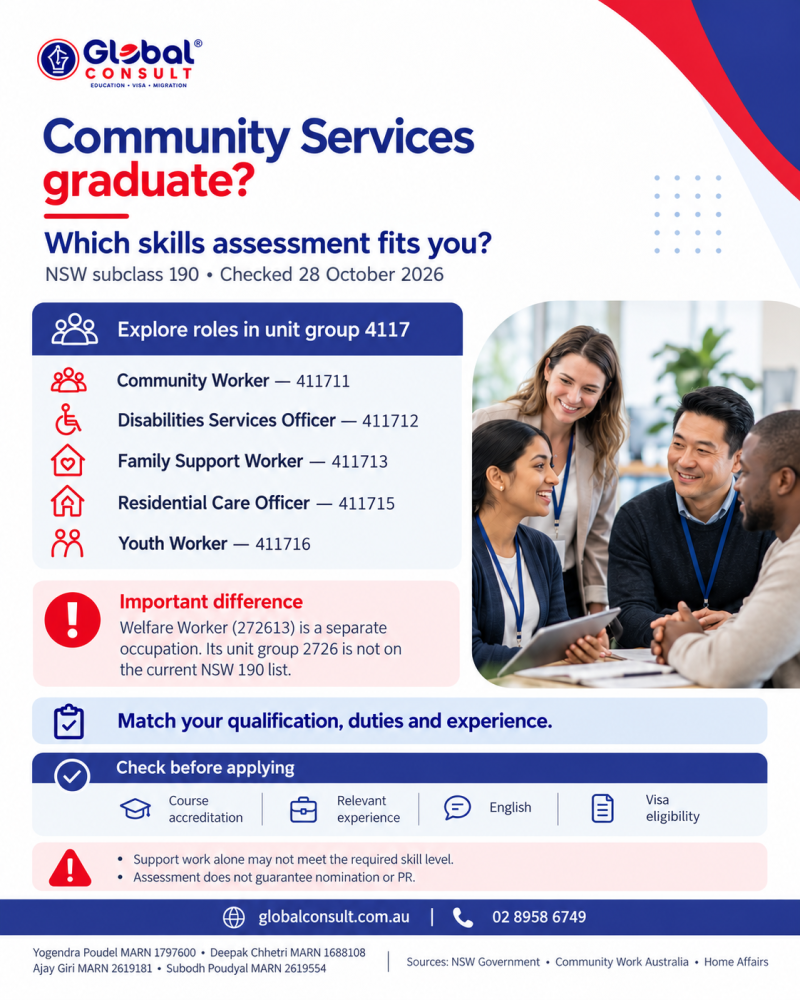
Checked against official sources on 28 October 2026 · General information Finished a Diploma or Bachelor of Community Services and wondering what to do next? Start with your qualification and the work you actually perform. A course title does not automatically decide your migration occupation. The...
Finished a Diploma or Bachelor of Community Services and wondering what to do next? Start with your qualification and the work you actually perform. A course title does not automatically decide your migration occupation.
Watch our short video explaining the key differences.
1. What does the NSW list mean?
NSW publishes occupation groups. You must also check whether your exact occupation is eligible for subclass 190 under Home Affairs rules. The current NSW notice updates the 190 list only; do not assume it also updates the regional 491 list.
A positive skills assessment and NSW nomination are separate decisions. NSW nomination is competitive and invitation-based. An eligible occupation does not guarantee an invitation, visa or permanent residence. Read the NSW 190 requirements.
2. Which occupation should I investigate?
These are potential matches to investigate, not a recommendation that every Community Services graduate qualifies. Community Work Australia assesses the five roles below. Compare the full occupation criteria with your course, placement and employment.
| Occupation | Work to focus on |
|---|---|
| Community Worker 411711 |
Helping clients access services, address barriers and participate in their community. |
| Disabilities Services Officer 411712 |
Assessing disability-related needs and coordinating access to services, education and support. |
| Family Support Worker 411713 |
Assessing family needs and providing support through family services, child protection or related settings. |
| Residential Care Officer 411715 |
Assessing and supporting children or people with disability in residential or group-care settings. |
| Youth Worker 411716 |
Direct work with young people, including programs that build skills, engagement and decision-making. |
Your duties matter more than your job title. “Support Worker”, “Case Manager” or “NDIS Coordinator” on a contract does not, by itself, establish an occupation match. See Community Work Australia’s occupation directory and the Home Affairs skilled occupation list.
3. Is finishing a Diploma enough?
Sometimes the qualification pathway includes placement; sometimes additional employment is required. For Community Worker, an eligible Community Work Australia accredited or recognised qualification can satisfy the industry-experience requirement through placement. Other relevant Diploma-or-higher applicants generally need one year of suitable paid, post-qualification experience within the previous four years. English and currency requirements still apply.
Accreditation must cover your specific course and campus for your entire study period. A recent qualification does not remove a separate employment requirement. Check the assessor’s Community Worker criteria before paying.
Specialist roles can require more experience
Disability Services Officer, Family Support Worker and Residential Care Officer distinguish between specialised and non-specialised qualifications. Their published pathways generally require:
- Relevant specialised qualification: one year of suitable employment in the relevant setting.
- Relevant non-specialised qualification: two years of suitable employment in that setting.
- Applicable accredited specialist pathway: placement can satisfy industry experience, subject to the occupation’s exact requirements.
Youth Worker also distinguishes specialist, accredited/recognised and non-specialist pathways. Read its criteria separately; do not assume a general Community Services Diploma is a youth-work specialisation. The linked occupation pages explain each pathway, including part-time equivalents.
4. Does working in disability or aged care automatically count?
No. Working in the sector is different from working at the required professional skill level. The assessor excludes certificate-level support work from relevant employment for these occupations, even when the workplace is similar.
Example: Maya has a general Community Services Diploma and provides personal care and household assistance. She should not assume those shifts qualify her as a Disabilities Services Officer. Her course pathway, actual responsibilities and evidence need review.
Example: Arun has a non-specialised relevant qualification and works in a family support service. He should check the two-year pathway rather than assume one year is enough.
5. What about Welfare Worker or Social Worker?
Welfare Worker — 272613: assessed by Community Work Australia, but different from Community Worker. Its current qualification page has a Bachelor-level heading while also mentioning an accredited Diploma pathway. Diploma holders should obtain written clarification from the assessor about their exact qualification. Even a suitable assessment does not put this occupation into the current NSW 190 list. Read the Welfare Worker criteria.
Social Worker — 272511: assessed by the Australian Association of Social Workers (AASW). A Community Services Diploma or Bachelor is not automatically a qualifying social work degree. Australian graduates should check whether their course is AASW-accredited and meets migration assessment requirements. Overseas social work qualifications require the relevant AASW assessment. Read AASW’s assessment information.
6. What should graduates focus on now?
- Choose a role that matches your training. Compare real duties and client groups with the assessor’s occupation description.
- Build the right experience. Seek supervised professional work involving needs assessment, case planning, referrals, advocacy and reviewing outcomes where relevant to the role. Changing a job title does not change the work performed.
- Keep evidence. Retain qualifications, transcripts, placement reports, accreditation details, employment references describing actual duties, paid hours and dates, payslips and any RPL records. Use the assessor’s document checklist.
- Check English and recent practice. An Australian Diploma alone does not automatically satisfy the study-in-English pathway. Check accepted tests or exemptions and the occupation’s currency rules.
- Check migration eligibility separately. Review age, points, English, valid assessment, NSW residence/work requirements and EOI accuracy. Investigate alternatives if NSW nomination is unsuitable.
Unsure which occupation fits your course?
Global Consult can review your qualification, placement and employment before you choose an assessment pathway.
Request a private assessment · 02 8958 6749
Include your name, email, contact number, course and campus, completion date, current visa and actual work duties. Please use the private form rather than posting personal information publicly.